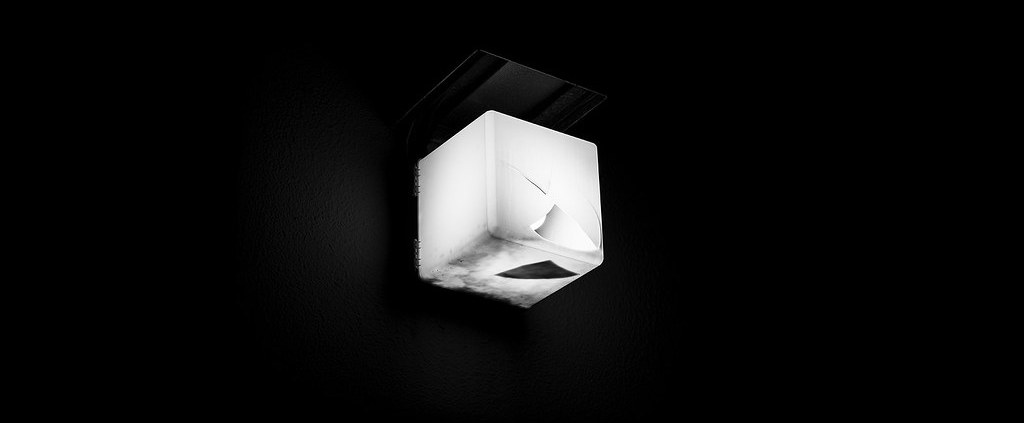

Strip away color. Strip away noise. What’s left? Light, shadow, shape and space. That’s where Helsinki-based photographer Mikko Luntiala does some of his best work. Shooting since 2006, Mikko has made an impression with his minimalist black-and-white photography by finding clean lines and quiet moments in the everyday scenes of his hometown. In this Photographer Spotlight, Mikko shares how he found his style, how less can feel like more and why he’s happy to keep photography a hobby.
“I bought my first DSLR camera in 2006; I think I was inspired in part by a photography class I took as part of my journalism studies.” As for his background in photography, Mikko explains, “At first, I experimented with different styles and techniques. You know how it is when you’re new to photography—it’s just cool to capture all kinds of things without thinking too much about style. It took me a while to figure out what truly inspires me as a photographer. Photography has always been just a hobby for me, and I intend to keep it that way. Trying to turn it into a profession would probably ruin it for me.”


As for style, it’s definitely Mikko’s approach to black and white minimalism that captured our attention. And he agrees, “For the past few years, my photography has mostly been about black-and-white minimalism, often with a touch of quirkiness or uneasiness. Someone once described one of my darker photos as scary minimalism. I took it as a compliment.”
“Style is not something I think about too much”, he continues , “I just let it happen naturally. That being said, I do pay attention to how my Flickr gallery looks as a whole. Recently, I’ve been sharing photos in groups of three. I pick a theme and share three photos within those boundaries. It’s a good way to create little photo projects for myself. Sometimes I forget about a photo for years and then find it again, thinking, Hey, this would go well with some of my recent photos!”
Here are a few of my favorites:


We know photographers find inspiration in a variety of spaces and we wanted to know what sparked Mikko’s creative direction when he heads out with his camera on hand. “I have to be in a specific mood to go out and shoot. I’m drawn to a certain sense of emptiness and solitude. Some might find it depressing or melancholic; I find it calming. Location doesn’t really matter to me. With a minimalist approach, there are good photos everywhere and in every kind of light. A cloudy sky, a white wall, or the darkness of night can all make great canvasses. Often, I find negative space to be just as important as the main subject.”
When searching for just the right subject, Mikko continues, “I try to look for things that aren’t tied to a specific place or time. Urban structures, trees, and lights are recurring subjects in my work. Sometimes the occasional person or bird makes an appearance. The people in my photos are distant and anonymous, on a journey through bleak surroundings and an indifferent universe. We are all just extras in someone else’s movie. I also like photographing things people usually walk past without looking twice. An air vent or a crack in a wall can make for an interesting photo because nobody pays attention to them.”


We asked Mikko about gear and he admits, gear is not his biggest focus. “I’m not a gear guy at all. I only have a Nikon D600, a proper brick of a DSLR, and a couple of zoom lenses covering 24 to 200 millimetres. If you mostly shoot still subjects and often use a tripod, you don’t need much else.” As for must haves, he does point out one of his go-tos, “I feel like people shooting urban locations tend to underestimate the value of a telephoto zoom. You can find new and interesting subjects and really isolate them if you’re willing to carry one with you—and don’t mind looking like a Nat Geo nerd.”
While many photographers and artists may focus on trying to portray a message or tell a specific story through their work, Mikko said his goal is the opposite. “You know how photographers often call themselves visual storytellers? I’m kind of the opposite of that. My photos are not stories. If there is a story, it’s in the mind of the viewer: What’s hiding in all that darkness—and what’s hiding in the light? What’s behind that lit window, and what’s the role of the observer standing outside? What’s outside the frame? Sometimes there are no answers, and that’s fine too.”


We asked Mikko to share one of his favorite photos with us and explain a little about how it came to be.
“This photo is part of a triptych I made in 2024. The style is unconventional for me, but the mood is not unlike that of my other street shots. I wanted to experiment with intentional camera movement, something I had always found fascinating but hadn’t really tried myself. I didn’t want to go full abstract, though, so I decided to combine the ICM technique with traditional photography. It was both a challenge to myself and a way to dig myself out of a creative rut I was in at the time.”

“I wanted to capture the blurry part and the person in the same location; otherwise, it would’ve felt wrong. First, I took some photos with intentional movement, swinging my 70–200mm lens up and down like a madman. What you see in the blur are some buildings and a tree, shot at one-tenth of a second. Five minutes later, the guy appeared exactly where I wanted him, and I took a snapshot of him.
“In editing, I converted both shots to black and white and combined them. I adjusted the contrast to my liking, and that was it. The end result is just as surreal as I had hoped; the person looks like he’s lost in a strange world or a dream. The feeling of being lost is something I often go for when photographing people, and this technique really amplifies that sensation.
“While rewarding in the end, the whole process was very unintuitive because I obviously couldn’t combine the shots in my camera to see what worked and what didn’t. Finding a good location for the blurry shot and capturing it in a compelling way was also difficult. I’ll definitely give this style another go at some point!”


Along with his photography Mikko also enjoys reading and listening to music and says, “Perhaps my photos give away my taste in books and bands. Non-visual arts often inspire my photography more than the work of other photographers—not that I don’t enjoy browsing through other people’s galleries looking for those hidden gems.”
As for the Flickr community we asked Mikko what keeps him coming back to share his photography here and he says, “Flickr, to me, feels more genuine than other platforms. It’s more geared towards photographers—people who appreciate high-resolution images and a clean-looking gallery. I also very much appreciate that the feed isn’t defined by an algorithm. If I follow someone, I want to see their work, and if people follow me, I want them to see mine. I certainly don’t want some influencer or political hot take popping up in my feed unsolicited. Curated galleries are also nice. It’s really cool when someone takes the time to create a gallery around a certain topic or style.”


If you want to stay in the loop with what Mikko is shooting and sharing on Flickr, give his Flickr site a follow and check him out on Instagram. And don’t be a stranger, he welcomes photo comments and FlickrMail messages if you want to chat about photography.